

VOSS Framework
These guides document the VOSS framework: a four-stage methodology for building and selling digital products with AI coding assistants. The framework is tool-agnostic (it works with Claude Code, Gemini CLI, or OpenAI Codex) and project-agnostic (it applies to any product you want to build). Whether you are creating a mobile app, an ebook, a template pack, or a SaaS tool, the process is the same.
VOSS Guides vs. Book Labs
Section titled “VOSS Guides vs. Book Labs”The VOSS Guides and the Book Labs cover the same four stages but serve different purposes.
VOSS Guides teach the methodology. They are project-agnostic: you follow them with your own product idea, your own audience, and your own vault. The guides explain what to do and why, then give you prompts you can adapt to any project.
Book Labs are guided tutorials. Each Book Lab walks you through the entire VOSS process using a specific project (Book 1 uses a Sleep Tracker, Book 2 uses a Time Boxing app, Book 3 uses a Water Tracker). The prompts are tailored to that project, so you can follow along step by step without making decisions about what to build.
What Is Offer Driven Development?
Section titled “What Is Offer Driven Development?”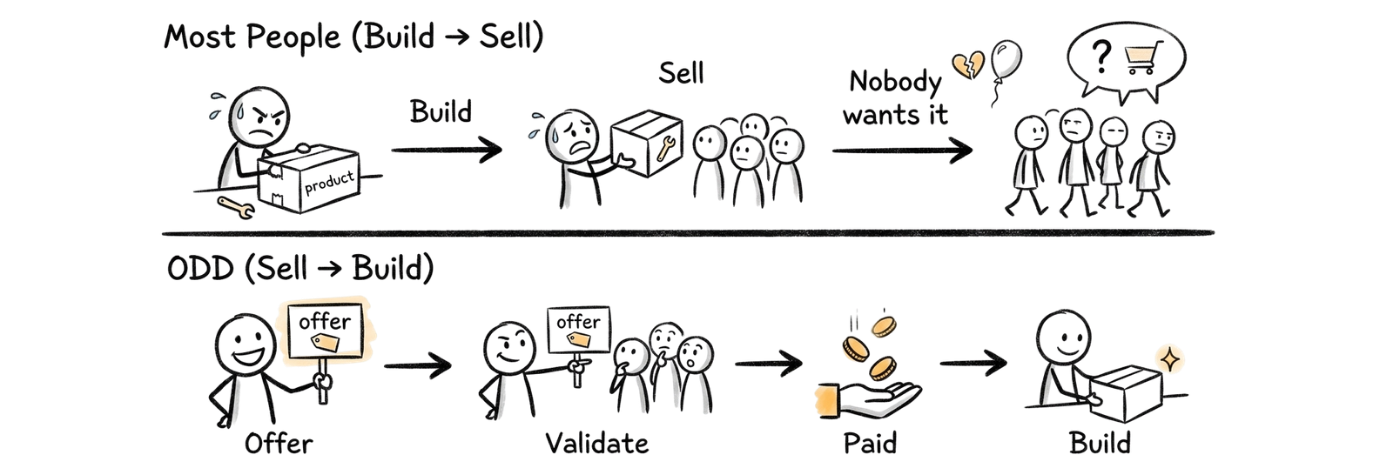
Offer Driven Development (ODD) is the principle that you should sell before you build. Most people do it backwards: they spend weeks building something, then discover nobody wants it. ODD reverses the sequence. You define your offer first, validate it with real customers, collect payment, and only then start building.
This matters because AI coding tools have made building fast. You can ship a working app in a day. But speed without validation just means you build the wrong thing faster. ODD ensures you are building something people will pay for before you invest your time in construction.
The test is simple: can you get ten people to pay for your product before it exists? If yes, you build. If not, you fix the offer or move on. No wasted weekends. No guessing.
The VOSS Framework
Section titled “The VOSS Framework”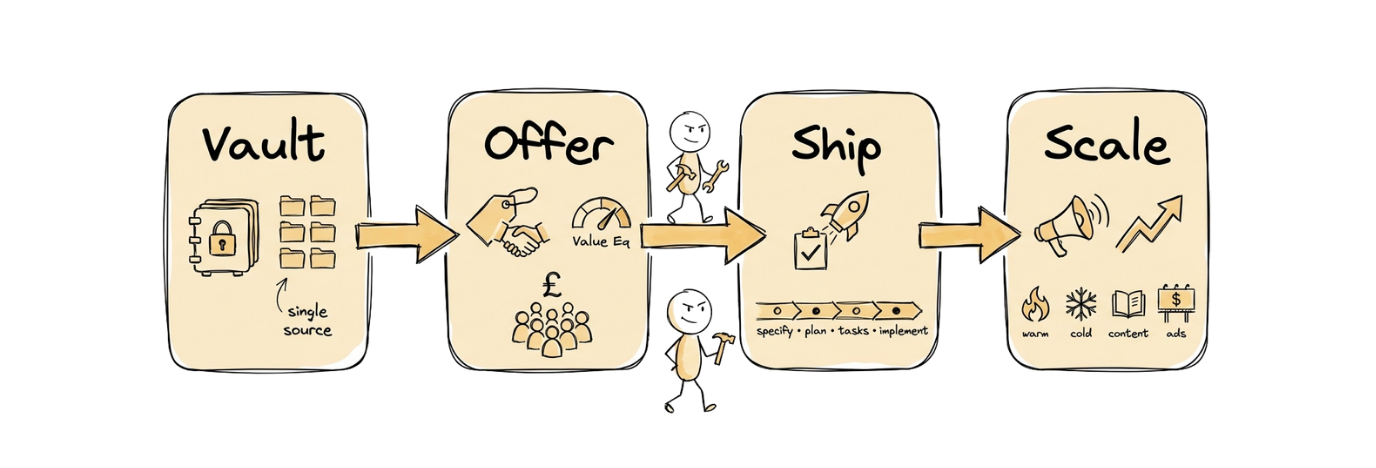
VOSS is the system that turns Offer Driven Development into a repeatable process. Four stages, each building on the last:
-
Vault. Organise your knowledge into a structured Obsidian vault. Your skills, stories, brand voice, audience profile, and product definition all live as markdown files in six canonical folders. The vault becomes the single source of truth that feeds every stage after it.
-
Offer. Define what you are selling, who it is for, and why they should care. Score your offer using the Hormozi Value Equation. Create a product listing, sell it to ten early adopters at a low price point, and prove demand before you write a line of code.
-
Ship. Build and deliver the product your offer promised. Use a specification-driven workflow (specify, plan, tasks, implement) to turn your product requirements into working software. You only build what the offer requires — nothing more.
-
Scale. Grow beyond your first ten customers. Start with warm outreach (the lowest friction channel), then layer on cold outreach, content creation, and paid advertising as you gain traction and refine your messaging.
How the Guides Work
Section titled “How the Guides Work”The VOSS Guides are designed to be followed in order. Each guide covers one stage of the framework and builds on the output of the previous stage. The Vault guide creates the knowledge base that the Offer guide draws from. The Offer guide validates the product that the Ship guide builds. The Ship guide delivers what the Scale guide promotes.
| Guide | What You Will Do |
|---|---|
| Vault | Set up your Obsidian vault with the canonical 6-folder structure and populate it with your project’s foundational documents |
| Offer | Define your offer, score it with the Value Equation, create a product listing, and sell to 10 early adopters |
| Ship | Turn your product spec into working software using the specify, plan, tasks, implement workflow |
| Scale | Build an outreach system starting with warm contacts and expanding to content and paid channels |
Every guide is project-agnostic. The prompts and instructions work regardless of what you are building. You supply the specifics (your product, your audience, your brand); the guides supply the structure.
What Comes Next
Section titled “What Comes Next”Head to the Vault guide to set up your Obsidian vault. The vault is the foundation of everything else in the VOSS framework — your offer, your product spec, and your outreach materials all start as files in the vault.