

Book 2: Offer
Why Time Boxing?
Section titled “Why Time Boxing?”You have 168 hours this week. You probably cannot account for 100 of them. Not because you are lazy. Because nobody ever taught you to track time deliberately. You track steps. You track calories. You track sleep. But time? You just let it happen and hope for the best.
Focus is the skill that unlocks everything else. Without it, knowledge work becomes a blur of half-finished tasks, context switching, and days that end with the question: “Where did the time go?”
Most people have tried some version of structured time. Pomodoro timers. Calendar blocking. Colour-coded planners. These tools count down, but they do not track up. You finish a Pomodoro and the timer resets. There is no record of what you did, how long it took, or whether your patterns shifted over time.
Time boxing is different because it is cumulative. Each session has a category, a duration, and a type. At the end of the week, you can see exactly where your hours went. That data changes behaviour in a way that a countdown timer never will.
In 2018, Marc Zao-Sanders published an article in Harvard Business Review that ranked 100 productivity techniques. Timeboxing came first. The simplest method: pick one thing, decide when you will do it, do it for a set amount of time, then stop.
We are building a time boxing app because it is a brilliant vehicle for learning ODD. The concept is simple enough that anyone can understand it. The audience is broad enough that validation is easy. The build is contained enough that you can finish it in a weekend.
The Time Boxing Value Equation
Section titled “The Time Boxing Value Equation”Here is how the Time Boxing offer scores against the Hormozi Value Equation:
Value = (Dream Outcome x Perceived Likelihood) / (Time Delay x Effort & Sacrifice)- Dream Outcome (8/10): Structured, focused days. You stop guessing where your time goes and start seeing it. The gap between “I worked all day” and “I can see I spent 6 hours in meetings and 45 minutes on deep work” is transformative.
- Perceived Likelihood (7/10): The method is proven (HBR ranked it number one). The app is simple (five screens, local storage, no backend). The build guide walks through every step with OpenAI Codex.
- Time Delay (1/10): Build the first vertical slice in a single session. Log your first timebox within minutes of the app running. No waiting period.
- Effort & Sacrifice (2/10): OpenAI Codex does the heavy coding. You write the spec. No backend to configure. No accounts to create. No server to maintain.
Score: (8 x 7) / (1 x 2) = 56 / 2 = 28.0. That is a very strong score. The denominator is tiny because you get results almost immediately and the effort is minimal.
What you will build
Section titled “What you will build”The Time Boxing app has five screens:
- Today View: See your planned timeboxes for the day. Tap to start one.
- Create Timebox: Set a title, category, duration, and type (hard or soft).
- Timer: A countdown that runs while you focus. Hard timeboxes stop when time is up. Soft timeboxes notify you but keep going if you are in flow.
- Weekly Review: Charts showing where your time went. Category breakdowns. Completion rates.
- Settings: Manage categories, set defaults, export your data.
Build Your Offer
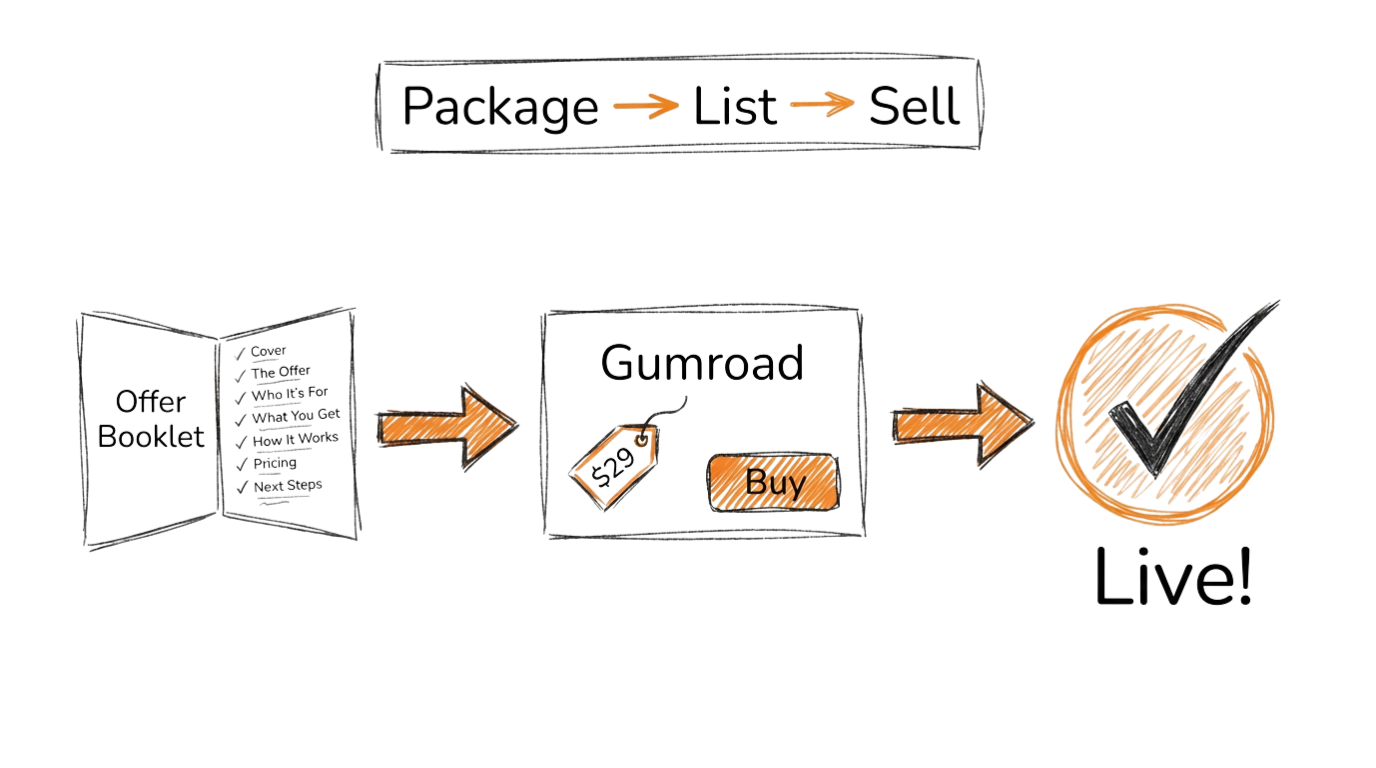
Section titled “Build Your Offer”The full offer guide walks you through generating an offer booklet, converting it to PDF, validating with the Value Equation, setting up a Gumroad page, and finding your first 10 early adopters.
The Offer Guide will use the vault files you created in the previous step. Your Time Boxing-specific content (brand voice, audience profile, offer definition) feeds directly into the offer booklet builder and outreach templates.
What Comes Next
Section titled “What Comes Next”Once you have a validated offer, a live Gumroad page, and (if you did the work) your first paying customers, move on to the Ship page. That page introduces the SpecKit workflow and walks you through building the Time Boxing app with OpenAI Codex.