

Book 1: Sleep Tracker Overview
What Is Offer Driven Development?
Section titled “What Is Offer Driven Development?”Most builders fall into the same trap: they build first, then try to sell. A weekend goes into an app. It works. It looks clean. And then nothing. A handful of downloads. Zero paying customers. The cycle starts again.
AI coding tools have made this worse, not better. Claude Code, OpenAI Codex, Gemini CLI: any of them can ship a working app in a day. That speed is brilliant. It is also dangerous. Speed without direction just means you build the wrong thing faster.
Offer Driven Development (ODD) flips the sequence. Instead of build then sell, you sell then build.
Before you write a line of code, you define the offer. What transformation are you promising? Who is it for? What will they pay? Then you ask ten people if they would pay for it. Not “do you think this is a good idea?” (everyone says yes to that). “Would you pay £10 for this?” That question gets honest answers.
If seven out of ten say yes, you build. If three say yes, you fix the offer. If zero say yes, you have saved yourself a wasted weekend.
The VOSS Framework
Section titled “The VOSS Framework”ODD is the philosophy. VOSS is the system that makes it work. Four stages, each building on the last:
-
Vault. Organise your knowledge into a structured Obsidian vault. Your brand voice, audience profile, product definition, and expertise go into six canonical folders as markdown files. The vault becomes the single source of truth that feeds every stage after it.
-
Offer. Define your offer, score it using the Hormozi Value Equation, and sell an offer booklet to 10 early adopters on Gumroad. The goal: ten people pay before you build anything. That is proof your idea has legs.
-
Ship. Build and deliver using SpecKit, a specification-driven workflow with four stages: Specify, Plan, Tasks, Implement. You only build what the offer requires. Nothing more. This constraint prevents feature creep.
-
Scale. Grow beyond your first ten customers. Start with warm outreach, then layer on cold outreach, content creation, and paid advertising as you gain traction.
In this Book Lab, the VOSS framework is not a separate set of guides. Each stage has its own dedicated page, tailored to the Sleep Tracker project you are building.
What You Will Build
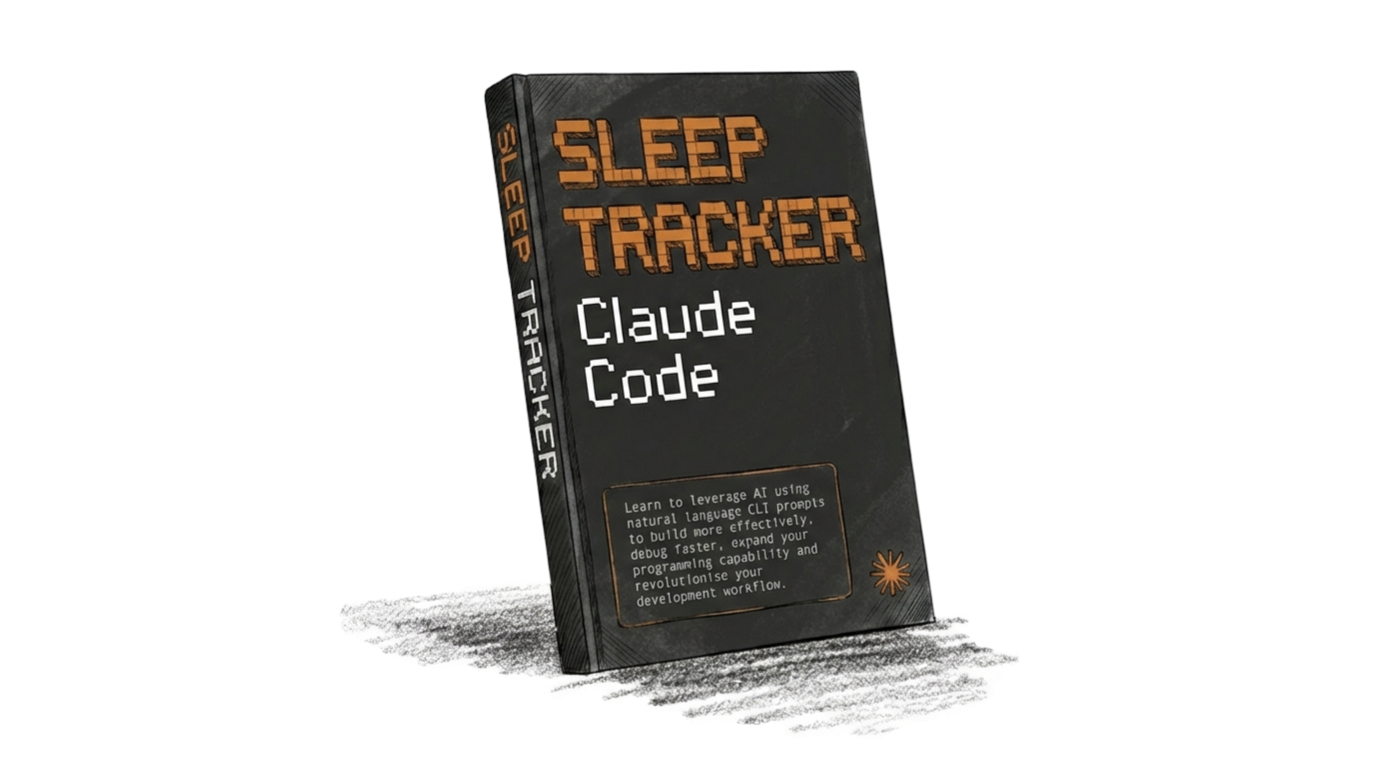
Section titled “What You Will Build”You will build a Sleep Tracker mobile application using Claude Code as your AI coding partner. The app lets users log their sleep each night, view their history, and understand their patterns over time.
The app has four screens:
- Home: today’s sleep summary at a glance (last night’s duration, quality rating, and a mini chart)
- Log Entry: record your bedtime, wake time, and rate your sleep quality from 1 to 5
- History: see all your past entries in a list
- Insights: a bar chart of the last 7 days, a line chart of quality over 30 days, and plain-English pattern summaries
No account. No cloud. No wearable required. Everything stays on your phone.
The sleep tracker is a teaching vehicle. What you are learning is the ability to build and sell any digital product, with any AI tool, for any audience. The methodology is the product. The app is the proof that it works.
This Book Uses Claude Code
Section titled “This Book Uses Claude Code”Every prompt in this Book Lab is written for Claude Code, Anthropic’s AI coding tool that runs in your terminal. Claude Code understands your entire project — it can read files, write code, run commands, and use the CoEngineers skills that power each step.
You need Claude Code installed before starting the Vault page. If you have not installed it yet, follow the Claude Code CLI setup guide — it covers installation, authentication, and verifying that everything works.
What Are Skills?
Section titled “What Are Skills?”Throughout this Book Lab you will see references to skills — pre-written instruction files that give Claude Code specialised knowledge about specific tasks like validating your vault or scoring your offer. Skills auto-activate when you describe a task in plain language.
The Prerequisites page explains how skills work, where they live, and how to install them. You need to download the skills starter before starting — the Prerequisites page has the download links.
Your Learning Path
Section titled “Your Learning Path”Each page in this Book Lab follows a stage of the VOSS framework:
| Page | VOSS Stage | What You Will Do |
|---|---|---|
| Vault | Vault | Set up your Obsidian vault for the Sleep Tracker project |
| Offer | Offer | Define, validate, and sell your offer to 10 early adopters |
| Ship | Ship | Build the Sleep Tracker app using Claude Code and SpecKit |
| Scale | Scale | Grow beyond your first 10 with outreach and content |
What Comes Next
Section titled “What Comes Next”Head to the Vault page to set up your Obsidian vault for the Sleep Tracker project. This is the first stage of the VOSS framework and takes approximately 30 minutes with Claude Code.